
Documentation
|
March 9, 2026
|
9 MIN

What’s the Difference Between Policy and SOP? Explained with Examples
What Is a Policy?
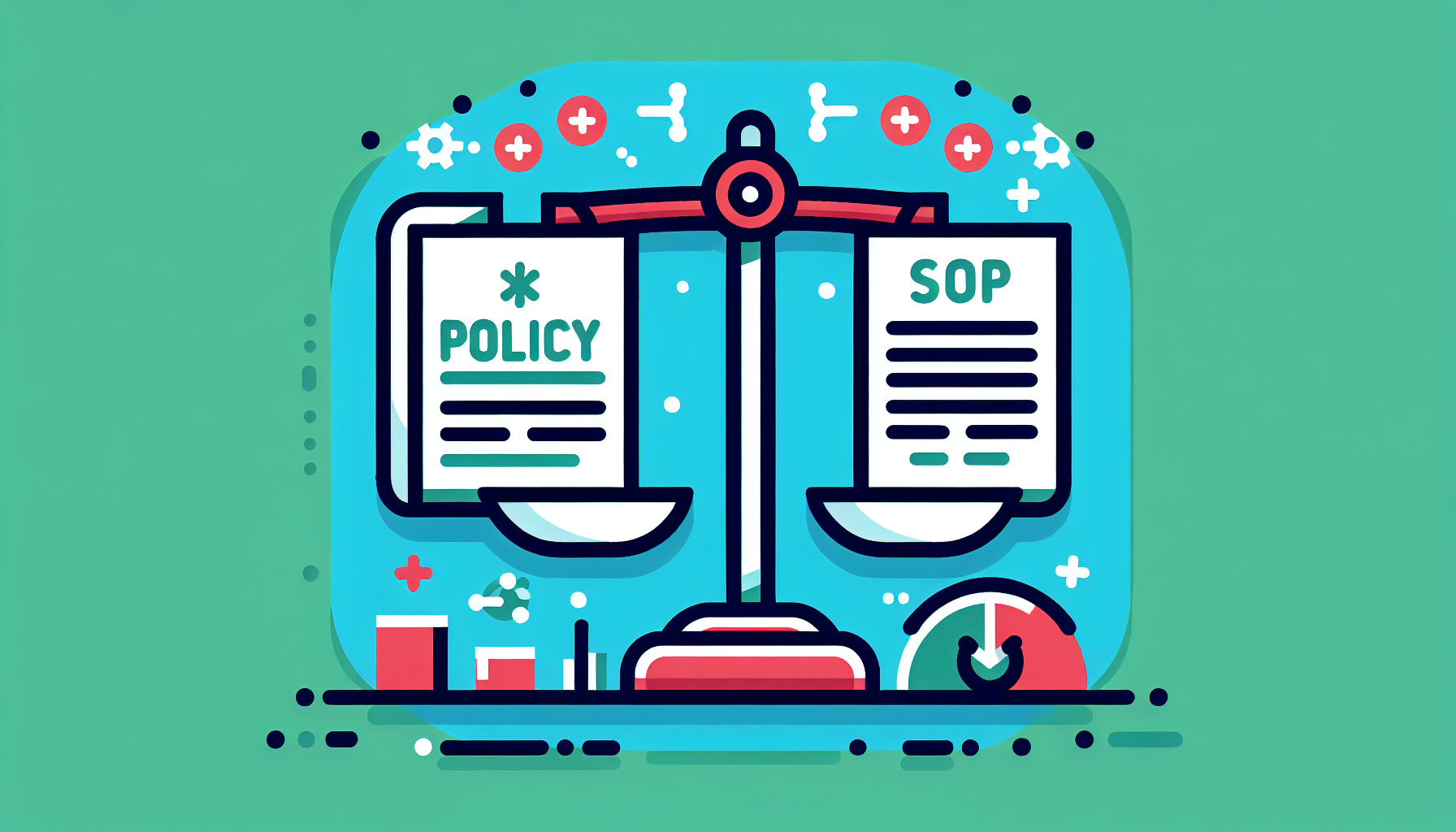
A policy is a formal document that expresses an organisation’s principles and commitments. It functions as a high-level rulebook for behaviour, decision-making, and priorities.
Policies make clear what needs to be followed and why it matters. These documents are shaped by legal frameworks, ethical commitments, or strategic goals, and they do not usually change very often. They focus on broad standards rather than day-to-day tasks.
For example, a company might have a privacy policy that states personal data must be handled in accordance with relevant laws such as GDPR. This sets an expectation but does not explain exactly how employees should meet the requirement.
Policies are often approved or authored by company leaders, compliance teams, or legal departments. They apply widely across the business, sometimes to all employees, and serve as a baseline for consistent behaviour.
What Is a Standard Operating Procedure?
A Standard Operating Procedure, or SOP, is an instruction-focused document that outlines how to complete a specific task.
SOPs are more tactical than policies. They are written for people performing the work and are designed to be followed as step-by-step instructions. The goal is to reduce errors, ensure repeatability, and ease training for new team members.
Consider a health and safety policy that requires protective equipment in specific work environments. The SOP tied to this policy would provide a detailed sequence of tasks for identifying, fitting, and inspecting that equipment before entering a hazardous area.
SOPs change more often than policies. As tools improve or new workflows emerge, the procedures get updated to reflect those changes. Unlike policies, SOPs do not explain why something must be done—they focus on how to do it correctly.
Policy and SOP Differences: How to Tell Them Apart
While both document types aim to guide people, they each solve different problems. The key differences are found in what they contain, who writes them, and how they’re used.
Policies define and guide decisions by establishing:
- Organisational rules
- Strategic commitments
- Legal or ethical expectations
They explain what must be done and who it applies to. Policies are broad and stable, relevant across departments, and often supported by legal or regulatory requirements.
SOPs define the actual activity by documenting:
- Specific steps or actions
- Required tools or resources
- Sequence of operations
They focus on execution, covering how to complete a routine task the correct way. These documents are narrower in scope, more flexible over time, and usually specific to teams or roles.
To illustrate this in a real setting, imagine a remote work policy outlines when employees may work from home and defines expected security measures. The SOP, in turn, provides instructions to configure secure access, set up a private network connection, and log working hours.
Each document amplifies the value of the other. Without policies, SOPs can lack authority. Without SOPs, policies are abstract and hard to apply.
Why the Difference Matters
Mistaking a policy for an SOP can lead to significant problems.
A policy without an SOP invites confusion. Employees know what is required, but not how to apply it. This opens the door to inconsistency, mistakes, or compliance failures.
An SOP without policy backing can also fail. It may misalign with broader goals or contradict standards that the organisation sees as critical.
The distinction also contributes to documentation clarity. People read policies to understand expectations. They read SOPs to figure out what to do. Mixing the two forms frustrates users, slows productivity, and creates doubt about which rules take priority.
Examples of Policies and SOPs Across Sectors
Clear documentation helps in every industry, but some environments highlight the need more urgently.
In healthcare, where regulations are strict and mistakes carry serious consequences, the difference between a policy and SOP is clearly defined. A common policy might require that informed patient consent be obtained before medical procedures. The SOP would spell out how to present the information, what forms must be signed, and how to log the process.
In manufacturing, safety policies often prohibit certain behaviours or require specific precautions. A common policy might prohibit machinery usage without proper safeguarding. An SOP in that environment would instruct workers on how to inspect and set up guard equipment each shift.
In technology and SaaS teams, data security is often enforced through policies demanding secure user login. The SOP would explain how to set up two-factor authentication or adhere to password protocols using enterprise software.
Each example shows how policies hold the rules, while SOPs provide the playbook.
Common Misconceptions About Policies and SOPs
Some organisations think of policies and SOPs as interchangeable. Particularly in early-stage teams, policies tend to get bundled with directions. While this may seem efficient at first, it becomes harder to scale or maintain over time.
Overusing policies to describe processes leads to ambiguity. It forces employees to make decisions based on interpretation, which raises risks.
Likewise, treating SOPs as everything—without anchoring actions in policy—can lead to teams working in ways that are out of sync with strategic aims. It also exposes organisations to legal issues if work is being done in ways that are inconsistent with regulations.
You can avoid these traps by thinking of policies as long-range maps, and SOPs as the detailed instructions for each journey.
Why It Pays Off to Get This Right
Defining policies and SOPs clearly is not just an exercise in documentation. It shapes how your organisation performs.
A good policy creates alignment. It says to teams: this is why we do things this way. It supports the company’s values, provides legal protection, and becomes central to how decisions are evaluated.
SOPs carry those values into the real world. They reduce variance in how work is done and prevent mistakes from repeating. They also make onboarding and training easier, because new team members do not need to figure things out from scratch.
Together, policy and SOP form a complete internal operations system. One sets the course. The other keeps everyone on track.
Best Practices for Writing Effective Policies and SOPs
When writing documentation, start by thinking about who will use it and what decisions or actions they need to take.
Keep these principles in mind:
Write policies for clarity. They should define intent, explain what is required, and state who is obligated to follow them. Stick to a structured format, especially if policies need committee or legal approval.
Write SOPs with precision. Aim for procedures that are easy to follow by someone new to the role. Include tools, locations, and criteria for completion. Avoid vague terms and favour stepwise instructions.
Keep things organised. Connect SOPs to the policies they support. Use shared templates to keep language and formatting consistent.
Schedule regular reviews. Policies may only need updates every year or two. SOPs should be reviewed more often, as operational tools change or feedback surfaces gaps.
Use documentation tools that allow updates to be versioned and tracked. This keeps your internal know-how audit ready and teams aligned.
Conclusion
Policies lay out the rules and expectations. SOPs tell people how to follow them. When organisations confuse the two, they waste time, introduce errors, and create friction across teams.
When handled properly, these documents remove uncertainty. They form the basis for trust, compliance, and efficient operations.
By maintaining both types of documentation and linking them clearly, you can strengthen your internal processes, reduce confusion, and scale your operations in a deliberate and controlled way.
Frequently Asked Questions (FAQs)
What is the main difference between a policy and SOP?
A policy outlines what needs to be done and why. It focuses on strategic goals and behavioural expectations. An SOP provides the detailed steps for how to perform a specific task. One defines intention. The other instructs execution.
Why do organisations need both policies and SOPs?
Policies guide decisions and ensure legal and ethical alignment. SOPs provide consistency in how tasks are done. Together, they allow organisations to operate with both clarity and control.
Can an SOP replace a policy?
No. An SOP cannot take the place of a policy. Policies define what must happen and why. SOPs describe how to meet those expectations. One cannot substitute for the other if clarity and compliance matter.
How often should policies and SOPs be reviewed?
Policies are usually reviewed once a year unless important changes require attention sooner. SOPs should be checked every six to twelve months or when new tools, risks, or errors appear.
Who writes policies and SOPs?
Policies are often written by senior leaders or those responsible for compliance and legal matters. SOPs tend to be drafted by teams who do the work each day, usually with help from supervisors or operations staff.
Can you have an SOP without a policy?
You can write an SOP without linking it to a policy, but doing so risks creating disconnects from your strategic goals. SOPs anchored in policy give workers confidence that they are following company expectations.
👍
What others are liking


5 Steps to outline your ideal documentation structure
5 MINS READ
Where to start the your journey of mapping out your ideal documentation structure, aligning it with the very heartbeat of your organization?
Defining a winning level of detail in your process
3 MINS READ
What is too much detail, and what is too little? This article described in that winning level detail about what detail is enough.


