
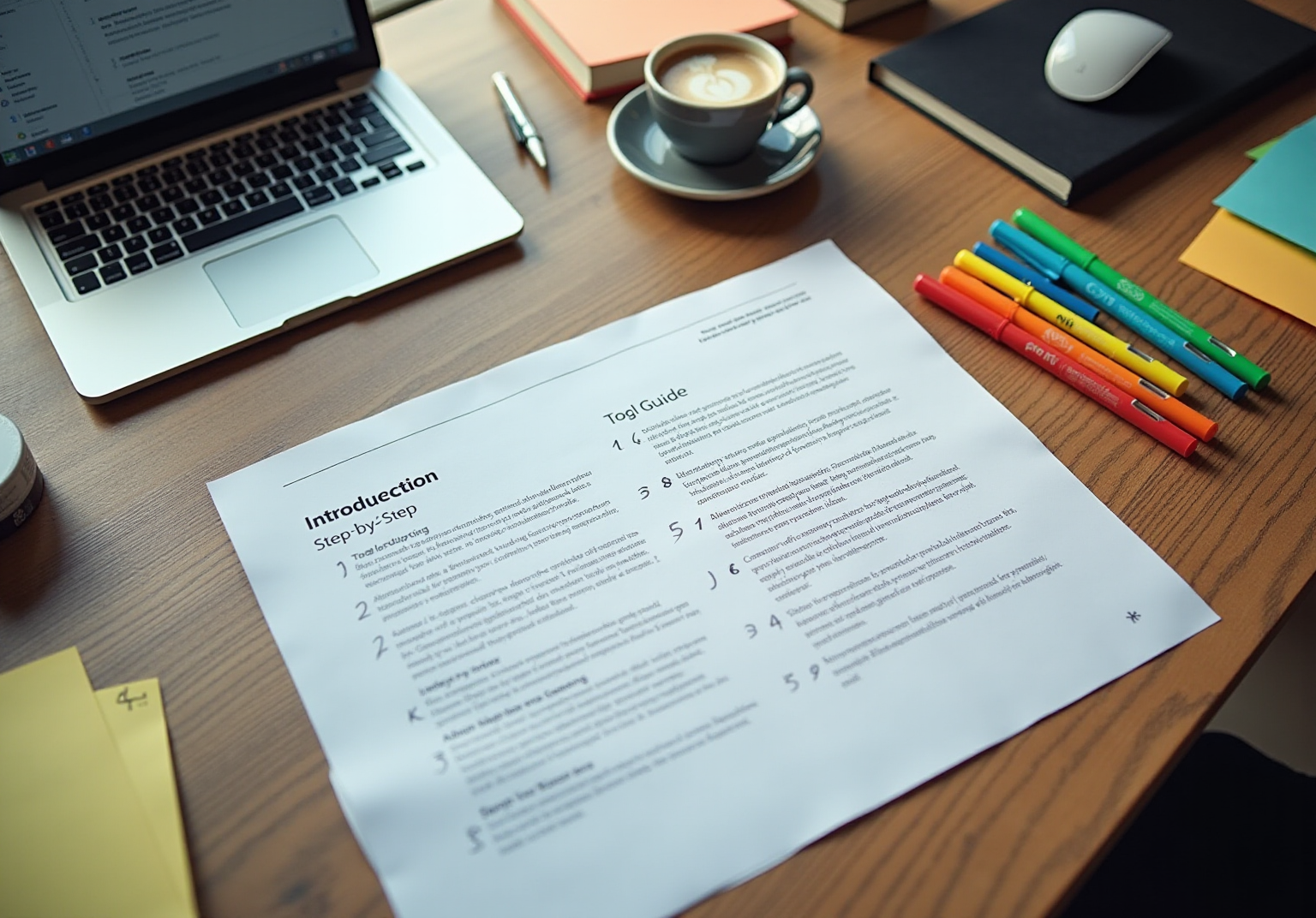

Key Highlights
- A step-by-step guide simplifies complex tasks into clear, actionable instructions.
- Effective mentorship is crucial for creating accessible documentation tailored to user needs.
- Identifying the target audience helps tailor content to their knowledge levels and preferences.
- Core elements of a guide include a title, introduction, step-by-step instructions, visual aids, and a conclusion.
- Clear instructions should start with strong action verbs to enhance clarity and engagement.
- Incorporating visual aids like screenshots and diagrams improves comprehension and retention.
- Using templates for repetitive tasks ensures consistency and saves time in documentation.
- Regularly reviewing and updating guides maintains their relevance and usability.
Introduction
You might be wondering how to create effective documentation that turns complex processes into manageable tasks. It’s a common struggle, right? This article dives into the essential steps for crafting a step-by-step guide using SowFlow, a tool that’s all about streamlining documentation and boosting clarity.
But what if the information feels overwhelming or just plain messy? Let’s explore how to tailor your content for your audience, sprinkle in some visual aids, and keep your guides relevant so they really resonate and help everyone understand.
Define a Step-by-Step Guide
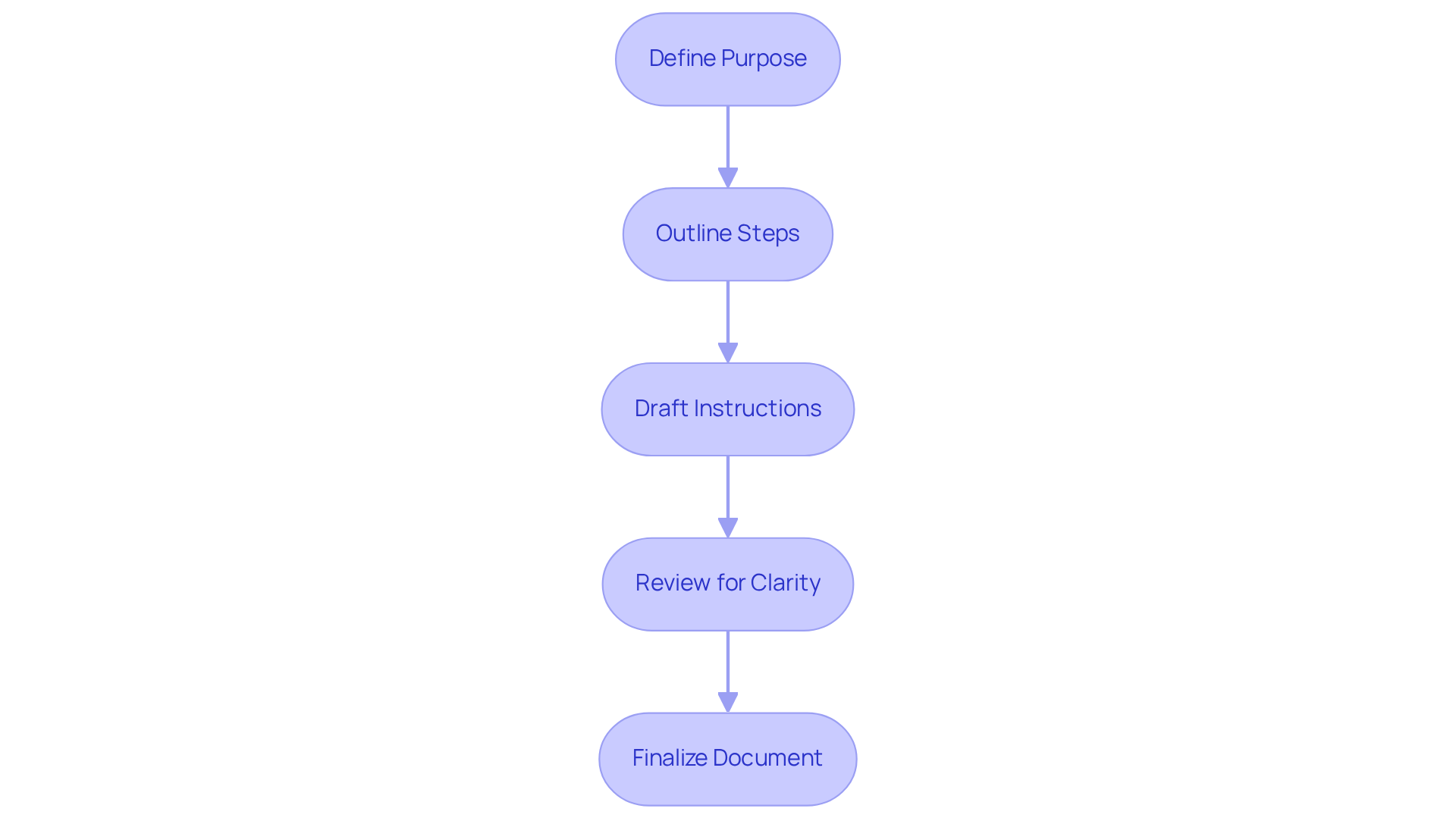
You might be wondering what a really is. Well, think of it as an organized document that shows how to make a , breaking down a process into simple, . Its main goal? To . It's essential to understand that lays out guiding you from start to finish.
Now, let’s talk about what makes a great mentor in this context. They should be , and really focused on what you, the user, need. This way, even if you’re new to the topic, you’ll find the information accessible. By keeping these elements in mind, organizations can whip up documentation that not only boosts understanding but also makes business processes run smoother.
For example, can take complicated workflows and turn them into manageable tasks. This can save you a ton of time - did you know that the average knowledge worker spends about 2.5 hours a day just searching for information? Crazy, right? Therefore, knowing how to make a with clearly defined instructions is key to streamlining operations and .
Identify Your Target Audience
You might be wondering why is so crucial for creating effective instructional content. Well, it’s all about making sure your materials hit home! Start by taking a good look at their demographics, knowledge levels, and specific needs. Surveys or interviews can be super helpful here - can really guide your approach.
For example, if your manual is aimed at new employees, you’ll want to to help them grasp the material. On the flip side, when you’re addressing seasoned professionals, feel free to incorporate . This not only but also significantly enhances the impact of your materials, ensuring they truly resonate with your audience.
Understanding your audience is essential. Just ask Anastasia Masadi, a Product Owner at SowFlow, who says, " in the way we document work and deliver to our clients. I do not have to take each screenshot separately, and do not even have to leave the browser while I am . SowFlow gave me time from my life back." This really shows how SowFlow not only ramps up efficiency but also , making it an invaluable tool for operations managers. So, how can you leverage this in your own work?

Outline Core Elements of the Guide
I am looking for information on how to make a . Let’s break it down together! Here’s a simple outline of the you’ll want to include:
- Title: Make sure to clearly state the purpose of your guide. This sets the right expectations from the get-go!
- Introduction: Give some context and let your readers know what they’ll learn. This helps them see why it matters.
- : Break the process into bite-sized, . This makes it easier for everyone to follow along.
- : Don’t forget to add images, diagrams, or screenshots! They really help reinforce understanding and make the info stick.
- Conclusion: Wrap things up by recapping the . And hey, invite your readers to share their feedback! It’s a great way to keep the conversation going.
This structured outline is your go-to framework for understanding how to make a that covers all the . By doing this, you’ll boost the clarity and effectiveness of your documentation, making it a breeze for your audience to navigate!

Write Clear and Actionable Steps
When you're crafting your guide, think about how to make a that keeps things simple and direct. You might be wondering how to do that? Start each step with a . For example, instead of saying, 'You should click on the button,' just say, 'Click the button.' This little tweak not only makes the instruction more effectively.
Now, let’s dive into the flow of your instructions. It’s super important to keep a . If you’ve got a procedure with several steps, you should learn how to make a by breaking it down into smaller tasks. This way, it’s easier for everyone to follow along. Research shows that can really boost comprehension rates, making it a breeze for folks to navigate through.
By focusing on practical measures, you’re helping users glide through the instructions, which leads to a smoother . And hey, writing specialist Allison Dunn puts it perfectly: 'Be clear, confident, and direct.' This advice fits right in with , which helps you whip up organized and user-friendly manuals in no time, keeping your documentation relevant and efficient.

Incorporate Visual Aids and Templates
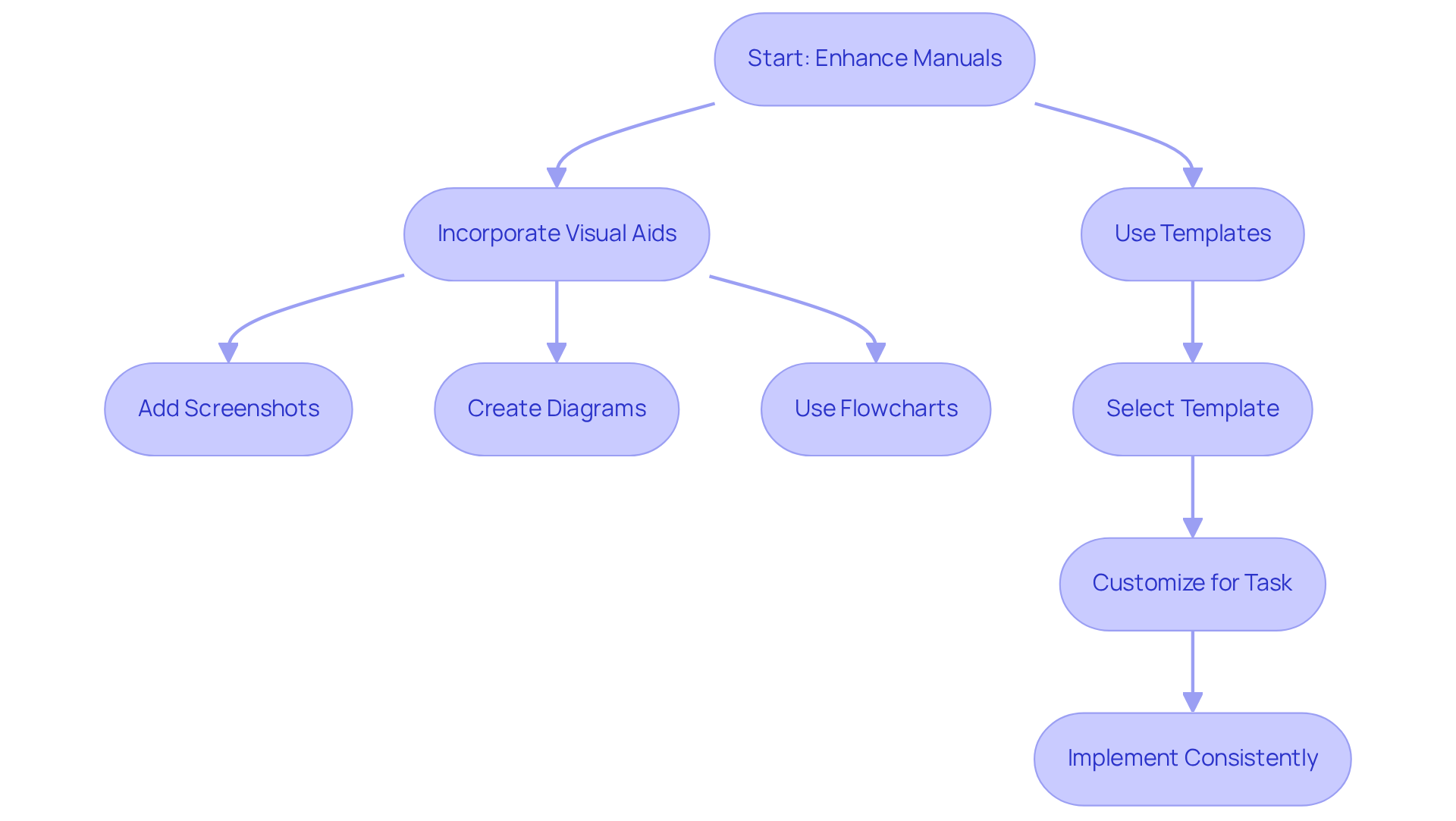
You might be wondering how to make a to enhance the effectiveness of your manuals. Well, incorporating can really help! They illustrate key steps clearly, making it easier for folks to follow along. For example, when guiding someone through software navigation, screenshots can simplify and make everything feel more manageable.
And let’s talk about templates for a moment. Using them for repetitive tasks not only keeps things consistent but also saves you a ton of time. Have you checked out ? They offer a variety of adaptable , which can really streamline your . It’s all about making the process easier for you!
Research shows that , helping to prevent confusion and enhance overall productivity. By mixing visuals and templates, you can learn how to make a that is not just informative but also captivating. This combination leads to for everyone involved. So, why not give it a try?
Review and Update Your Guide Regularly
You might be wondering how often you should review and update your guide. Well, it’s crucial to establish a routine for this - ideally every six months or whenever there are . Regularly from participants is key to spotting areas that might need a little improvement or clarification. You can gather this in various ways, like through surveys, usability tests, or even just chatting directly with individuals. These methods have been shown to really .
For example, organizations that actively close the loop often see . Pretty impressive, right? Speaking of that, using tools like the Yes/No widget in ClickHelp can make a breeze. Plus, keeping an eye on any changes in the tools or processes mentioned in your manual helps ensure that your content remains accurate and relevant.
By committing to , you’re not just maintaining the guide’s value as a resource for how to make a ; you’re also empowering users to navigate their tasks more efficiently and effectively. So, why not take that step? It’s all about !

Conclusion
Creating a step-by-step guide is a fantastic way to simplify complex tasks and boost productivity, right? By breaking down procedures into clear, actionable instructions, you and your organization can make sure your documentation is not just user-friendly but also effective in meeting your audience's needs.
You might be wondering what key strategies can help with this. Well, we’ve talked about a few important ones:
- Identifying your target audience
- Outlining core elements
- Writing clear steps
- Incorporating visual aids
- Regularly reviewing and updating your guides
Each of these components is crucial for crafting a comprehensive manual that really resonates with users, making it easier for them to navigate processes and achieve their goals.
Now, let’s not underestimate the significance of well-structured guides. They’re essential resources that empower users, streamline operations, and foster better communication. Speaking of that, embracing tools like SowFlow can really enhance this process. They provide templates and visual aids that save time and improve clarity. By committing to these best practices, anyone can create effective step-by-step guides that not only inform but also inspire confidence in users as they tackle their tasks.
Frequently Asked Questions
What is a step-by-step guide?
A step-by-step guide is an organized document that breaks down a process into simple, easy-to-follow instructions, making complex tasks easier to understand and execute.
What are the essential qualities of a great mentor for creating a step-by-step guide?
A great mentor should be clear, organized, and focused on the user's needs, ensuring that even newcomers can access and understand the information.
How can structured documents benefit organizations?
Structured documents can simplify complicated workflows into manageable tasks, saving time and increasing productivity by reducing the hours spent searching for information.
Why is it important to identify your target audience when creating instructional content?
Identifying your target audience is crucial to ensure that your materials effectively address their demographics, knowledge levels, and specific needs, making the content more relevant and impactful.
How can surveys or interviews help in understanding the target audience?
Surveys or interviews can provide insights into the audience's preferences and challenges, guiding the approach to content creation and enhancing usability.
What should be considered when creating materials for new employees versus seasoned professionals?
For new employees, it is important to emphasize basic terminology and foundational concepts, while for seasoned professionals, advanced techniques and industry-specific jargon can be incorporated.
How does the tool SowFlow aid in the documentation process?
SowFlow streamlines the documentation process by allowing users to create standard operating procedures (SOPs) and training materials without taking separate screenshots or leaving the browser, thus improving efficiency.
List of Sources
- Define a Step-by-Step Guide
- Importance of Documentation | The Workstream (https://atlassian.com/work-management/knowledge-sharing/documentation/importance-of-documentation)
- The Importance of Technical Documentation: A Guide to Clarity and Success (https://gurzu.com/blog/importance-of-technical-documentation)
- Importance of Documentation - Expert and Influential Leader Quotes : Erase Your Risk with Proper Documentation (https://forensicnotes.com/importance-of-documentation-expert-and-influential-leader-quotes)
- Why Is Documentation Important? 6 quotes | Adam Stahl (https://linkedin.com/posts/adam-stahl-44857632_why-is-documentation-important-6-quotes-activity-7143283976084877312-uTMA)
- Identify Your Target Audience
- 11 Documentation Statistics to Make You Rethink Process in 2025 - Whale (https://usewhale.io/blog/documentation-statistics)
- databox.com (https://databox.com/how-to-identify-the-target-audience-for-your-website)
- 31 Target Audience Stats Across The Social Media Platforms (2021) (https://notifyvisitors.com/blog/target-audiences-stats)
- hearststorystudio.com (https://hearststorystudio.com/post/10-powerful-quotes-on-the-importance-of-knowing-your-audience)
- veracontent.com (https://veracontent.com/mix/knowing-your-audience-great-marketing)
- Outline Core Elements of the Guide
- The Benefits of Outlining (https://statisticssolutions.com/the-benefits-of-outlining)
- Effects of outlines and information seeking on learning outcomes in video-based environments (https://tandfonline.com/doi/abs/10.1080/10494820.2022.2028854)
- Feb06_article05 (https://itdl.org/Journal/Feb_06/article05.htm)
- blog.brookespublishing.com (https://blog.brookespublishing.com/10-great-quotes-about-effective-reading-instruction)
- 70 Research Quotes to Inspire Your Work - Qualtrics (https://qualtrics.com/articles/strategy-research/research-quotes)
- Write Clear and Actionable Steps
- Writing and Using Learning Objectives | CBE—Life Sciences Education (https://lifescied.org/doi/10.1187/cbe.22-04-0073)
- Frontiers | A Pragmatic Master List of Action Verbs for Bloom's Taxonomy (https://frontiersin.org/journals/education/articles/10.3389/feduc.2020.00107/full)
- 100 Inspiring Writing Quotes to Sharpen Your Skills (https://deliberatedirections.com/writing-quotes)
- (PDF) Using Action Verbs as Learning Outcomes: Applying Bloom’s Taxonomy in Measuring Instructional Objectives in Introductory Psychology (https://researchgate.net/publication/275068385_Using_Action_Verbs_as_Learning_Outcomes_Applying_Bloom's_Taxonomy_in_Measuring_Instructional_Objectives_in_Introductory_Psychology)
- Choosing action verbs | Staff | Imperial College London (https://imperial.ac.uk/staff/educational-development/teaching-toolkit/intended-learning-outcomes/choosing-action-verbs)
- Incorporate Visual Aids and Templates
- The Ultimate Guide to Business Documentation Templates: Streamline Your Operations (https://whisperit.ai/blog/business-documentation-templates)
- Top visual learning statistics of 2025 | SC Training (https://training.safetyculture.com/blog/visual-learning-statistics)
- Top Visual Learning Facts and Statistics for 2024 (https://wp-tonic.com/top-visual-learning-facts-and-statistics-for-2024)
- Exploring Visual Learning Animations Statistics (https://educationalvoice.co.uk/visual-learning-animations-statistics)
- 11 Documentation Statistics to Make You Rethink Process in 2025 - Whale (https://usewhale.io/blog/documentation-statistics)
- Review and Update Your Guide Regularly
- clickhelp.com (https://clickhelp.com/clickhelp-technical-writing-blog/maximizing-user-satisfaction-improving-technical-documentation-with-user-feedback)
- 20 People Management Tips And Quotes For Managers (https://fca.edu.sg/blog/people-management-tips-quotes-for-managers)
- getthematic.com (https://getthematic.com/insights/building-effective-user-feedback-loops-for-continuous-improvement)
- 39 Interactive Learning Statistics: 2026 Data, Trends & Predictions | Research.com (https://research.com/education/interactive-learning-statistics)
👍
What others are liking


5 Steps to outline your ideal documentation structure
5 MINS READ
Where to start the your journey of mapping out your ideal documentation structure, aligning it with the very heartbeat of your organization?
Defining a winning level of detail in your process
3 MINS READ
What is too much detail, and what is too little? This article described in that winning level detail about what detail is enough.


